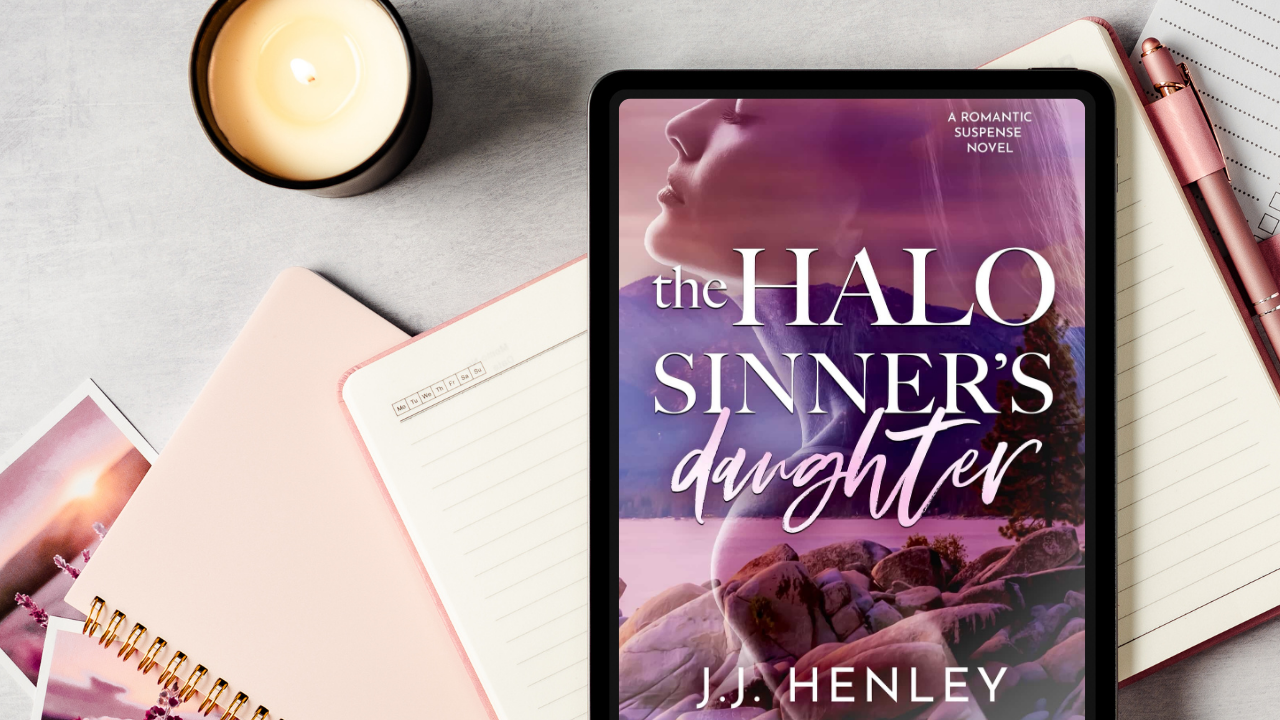
Student Spotlight: How J.J. Henley Finished Her First Draft in 8 Months (With Two Kids and In 15 Minutes at a Time)
If you've ever told yourself you'll get serious about your novel when life calms down, when the kids are older, when work settles, or when you actually have time, this post is for you.
Because I recently sat down with Jackie Henley, who writes under the pen name J.J. Henley, and her story completely challenges that belief. Jackie finished her debut romantic suspense novel in eight months—and she did it with two kids at home, a newborn who stopped sleeping, and while her family was walking through one of the hardest seasons of their lives. (More on that in a minute.)
She wrote in the In-N-Out drive-through, at the dance studio, during swim lessons, and sometimes just three sentences at a time.
And she finished her novel.
Jackie went through my Notes to Novel program—she actually signed up right before having her second baby, knowing she'd have to pause and come back to it—and in this conversation, she shares every stage of her journey. The spark that gave her the confidence to start, the parts of the process she fought the hardest, and what it actually felt like to type those two final words: The End.
Here's what she shared.
Why Beta Reading Someone Else's Novel Changed Everything
Jackie had been in the book community for years, reviewing stories on her Bookstagram account and following authors she loved. She had her own story ideas, but for a long time, she didn't believe she could actually write one.
That changed when a friend asked her to beta-read her romance novel.
"It puts you on a leveled playing field with other people," Jackie told me, "Where you realize, oh my gosh, we all don't know what we're doing."
Seeing a story in its messy, unpolished, work-in-progress state was what finally lowered the barrier of entry for her. It wasn't a published book on a shelf. It was a Word doc with notes in the margins. And Jackie realized that's all it is at the start.
If you're sitting on a story idea and wondering whether you're qualified to write it, beta reading is one of the most underrated ways to build confidence as a writer. It shows you that every author starts somewhere messy.
What Happened When She Enrolled in Notes to Novel Right Before Having a Baby
Jackie signed up for Notes to Novel in March 2023, knowing she only had a few weeks before her second baby arrived. She asked for it as a birthday present.
She didn't finish the course before her son was born. She took a full year away from writing. But when she came back in late 2024, she picked up where she left off, and that's when everything started to click.
The takeaway here isn't about perfect timing. It's about making the decision even when the timing isn't ideal, because waiting for the right moment is one of the most common ways writers talk themselves out of starting altogether.
Why Jackie Resisted Calling Her Book a Thriller With a Romance Subplot
When Jackie got to the section of Notes to Novel where we identify your story's content genre (the underlying story type that governs your key scenes and what readers need to feel satisfied), she completely dug her heels in.
Her story had a serial killer at its center, but she knew she wanted to write for readers who loved romance. Jackie knew the romantic elements needed to be just as strong as the thriller elements, and so she resisted, hard, the idea of labeling her book a thriller with a romance subplot rather than the other way around.
"It gave me the heebie-jeebies," she said. "Nails on a chalkboard. I couldn't do it."
But as she worked through the course, building her theme, developing her characters, and eventually getting to the outline, something shifted. She started to see that getting the content genre right allowed her romance and thriller elements to work together rather than compete.
This is something I see constantly with Romantasy writers, too. They resist calling their book an action-adventure story with a romance subplot, even when that's exactly what it is structurally. But getting this right at the foundation stage doesn't limit your story. It frees it. It tells you what your key scenes need to do and how to make both storylines feel satisfying rather than one feeling like an afterthought.
Getting clear on content genre is hard. But it's one of the most important decisions you'll make, and Jackie's finished book is proof of that.
How a Scene-by-Scene Outline Made 15-Minute Writing Sessions Actually Count
Once Jackie had her outline done, something shifted in how she wrote.
"I could write three sentences," she told me, "and it made jumping back into the paragraph later, once my kids had gone to bed, that much easier."
She wrote a lot of her novel in the In-N-Out drive-through. At her daughter's dance studio. During her son's swim lessons. And none of those sessions felt wasted, because she always knew exactly where she was going.
This is the thing I want writers to understand about outlining: it's not a creative cage. It's what makes small writing windows genuinely productive. Without an outline, three sentences in a drive-through line are just three sentences. With one, those three sentences move your story forward.
The other key to Jackie's speed? She committed to fast drafting—a technique where you write straight through to the end without going back to revise. Once a scene was done, she didn't touch it. No rereading. No polishing. Just the next scene. It felt uncomfortable at first, but it's what kept her from stalling out and rewriting the same pages over and over.
Jackie also said she never felt stressed about losing the thread of her story, even during long stretches away from writing. The outline was there. The story wasn't going anywhere.
If you're writing without an outline and feeling anxious every time you step away from your manuscript, this might be why.
Finishing the Draft When Life Got Really Hard
In October of her drafting year, Jackie's son stopped sleeping. Her writing windows disappeared almost entirely. And if that wasn't enough, her dad was diagnosed with cancer—one of the hardest things a family can face, and she was in the middle of it while trying to finish her book.
She scaled back when she needed to. She gave herself grace. And she reminded herself that this wasn't all or nothing.
She'd wanted to finish in six months. She finished in eight.
"I was like, oh, this is fine," she said. "Two months past the date I wanted, and I finished."
Eight months is not a long time to write a novel. And the reason she could say "this is fine" instead of spiralling is that she had a system she trusted. The outline was there. The story wasn't going anywhere. She didn't feel behind—she felt on track, just at a different pace.
That's what the right system does. It doesn't just help you write. It helps you come back.
What It Felt Like to Type "The End"
When Jackie was a few pages away from finishing, she set up her phone and recorded herself typing the final words.
She cried.
"I knew that it was complete," she told me. "I knew I'd worked through the hard stuff."
Her first draft had a lot of telling and not much showing. There were TKs scattered throughout. Words she'd overused. Scenes that needed work. But she could pick it up and follow the full story from beginning to end, and that, she said, was everything.
That's what a finished first draft is supposed to be. Not perfect. Not polished. Just complete. Because you cannot edit what doesn't exist, and you cannot find your patterns as a writer until you have a full manuscript in front of you to learn from.
Her Honest Take on Self-Publishing
By the time Jackie was ready to publish, she'd spent years reviewing novels in the book community and had noticed a pattern. The books she loved most were overwhelmingly indie-published.
"If you can stop thinking about getting your investment back," she said, "because that's not going to happen the first time around, you'll be a lot happier."
That's honest. And exactly the kind of perspective first-time authors need to hear.
That observation completely reframed how she thought about her own publishing path. She's self-publishing her debut and approaching it with intention, focusing on reviews before launch, building organic reader relationships through her Bookstagram, and playing the long game. Not because traditional publishing wasn't an option, but because indie felt like the right fit for her story, her audience, and the creative control she wanted.
Ready to Write Your Own Novel?
Jackie's story is such a good reminder that finishing your novel isn't about having perfect conditions or unlimited time. It's about having the right system and trusting it, even when life gets messy, even when you only have 15 minutes, even when things are hard.
If you read Jackie's story and thought, I want results like that—the finished draft, the confidence, the clarity of knowing exactly what scene comes next when you sit down to write—then Notes to Novel might be exactly what you're looking for.
Notes to Novel is my step-by-step program that takes you from scattered ideas to a finished first draft. You'll learn how to build a solid foundation for your story, create a scene-by-scene outline you actually trust, and make consistent progress even if you only have 15 minutes at a time.
Join the waitlist to be the first to know when enrollment opens again.
Like this post? You might also like…