Student Spotlight: How Grace Draven Learned to Write Faster (Without Sacrificing Quality)
There's a belief most writers carry without ever saying it out loud: that writing fast means writing badly. You hear the words "fast drafting" and picture a sloppy, throwaway mess you'll just have to gut and rewrite anyway. So going faster starts to feel like a trade-off—speed or quality, never both.
If that sounds familiar, I want you to meet Grace Draven. Grace has written more than 20 books, hit the USA Today bestseller list five times, and was writing fantasy romance before "romantasy" was even a word. When Grace joined my Notes to Novel program, she had one goal in mind: to learn how to write faster without sacrificing the quality her readers count on.
And she did—not by becoming a different kind of writer, but by changing a handful of key things about how she approached her work. Here's what made the difference for Grace, and what can make it for you.
3 Shifts That Helped Grace Write Faster
#1. An Outline Can Be Flexible, Not a Cage
If the word "outline" makes you want to close your laptop, you're not alone. For most of her career, Grace believed outlining was the death of creativity. To her, "structure" meant the rigid essay outline from school—thesis, three body paragraphs, conclusion—the kind that boxes you in before you write a word.
Here's what she learned, and what I want you to hear: an outline doesn't have to work that way. It can be a living document, one that gives your story enough shape to hold together while leaving plenty of room to discover. Guideposts, not a locked-in map. It changes as you get to know your story. It keeps you from wandering without deciding every turn in advance.
Once Grace saw that, everything loosened up. She could still be a discovery writer. She could still follow the spark. She could still surprise herself on the page—she just wasn't staring down a blank document with no idea where she was headed.
So this is the first belief to let go of: that an outline and your creativity can't coexist. Done right, the outline is what frees you to be creative, because you're no longer holding the entire story in your head at once.
#2. Think in Scenes, Not Chapters
If you've ever gotten tangled up trying to figure out where your chapters should break, or how to connect one to the next, you may be solving the wrong problem.
Grace used to build her books chapter by chapter, wrestling over where each one should end. But that kept her attention on the packaging instead of the story. The shift that saved her the most time was learning to think one level down—in scenes instead of chapters. Instead of asking "How do I connect these chapters?" she started asking "How does this scene lead into the next one?"
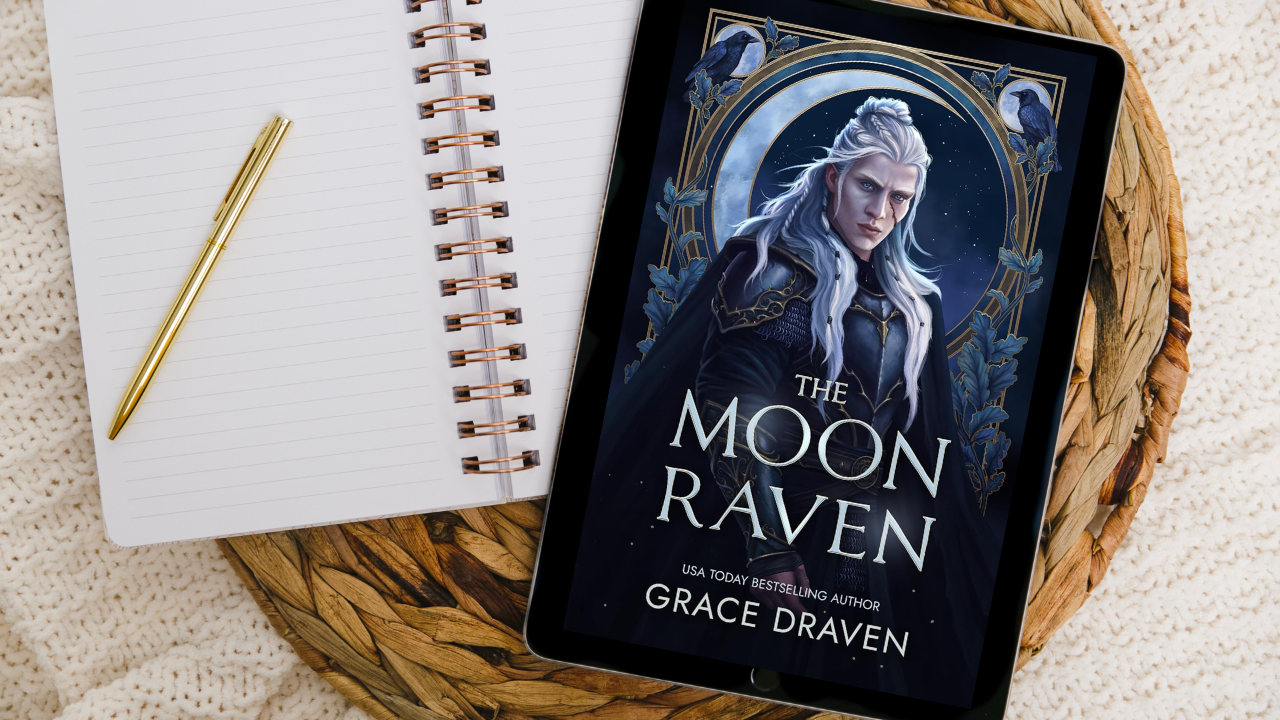
Once your scenes connect with real cause and effect, the chapter breaks stop being a puzzle. They land at the natural seams between well-built scenes. Grace put this to work on her novel The Moon Raven, which juggled dual points of view, dual timelines, and flashbacks—not exactly a simple build—and the whole thing got more fluid. The scenes carried the momentum, and the chapters got far easier to shape around them.
So if chapters are where you get stuck, stop starting there. Get your scenes flowing into each other first, and the rest gets much simpler to handle.
#3. Build Your Antagonist Before Your Hero
Most of us build our protagonist first. We know who the story's about, what they want, and where they're headed—and the antagonist becomes something we bolt on later. If you've ever hit the middle of a draft and realized your antagonist feels flat, your conflict isn't escalating, or your stakes are soft, this is usually why.
Grace worked this way for years, and it cost her. Flat antagonists meant circling back to retrofit the whole story around a stronger opponent. So she flipped the order. She started with the antagonist—figuring out what they wanted, what they feared, and what they were planning—before she shaped her protagonist against them.
The story sharpened immediately. Once the opposition was clear, the stakes rose and her protagonist's motivation came into focus, because now there was real pressure to push against. And because she'd done that thinking up front, she knew where the story was going before she wrote the bulk of it. Fewer words thrown out. Fewer late-stage fixes.
The key takeaway? Your antagonist isn't a character you save for last. Work them out first, and everything about your protagonist—and your draft—gets easier.
What Those Shifts Made Possible
Those three shifts weren't theoretical. Grace put them to the test under about as much pressure as a writer can face.
She had an Amazon preorder deadline she'd already pushed back once and couldn't move again—and then, in the middle of it, a serious health scare landed. With 20,000 words down and the clock running, she drafted another 62,000 by hand, in spiral notebooks, in 21 days, and uploaded the file with about 90 minutes to spare.
And here's the part that matters most: the speed didn't cost her quality. Her editor and her beta reader both read the draft and called it solid. She wasn't cranking out a throwaway mess to fix later—she was writing fast and writing well at the same time, because the most important story decisions had already been made.
That confidence carried forward, too. When Grace later landed a multi-book publishing deal and had to commit to delivery dates, she could answer with more certainty than she would have in the past—not because writing suddenly became easy, but because she had a process she could trust.
That's the whole promise in one story. Not that you need a 21-day sprint or a publishing deadline. But once your foundation is set, drafting becomes execution instead of guesswork—and that's how speed and quality stop being a trade-off.
You Don't Need Perfect Conditions—You Need a Process That Survives Real Life
Here's what makes that sprint even more remarkable: Grace didn't pull it off in ideal conditions. She never does.
She writes around constant interruptions at home, including caring for her son, and she can't shut herself away for hours. What keeps her moving anyway isn't more time—it's having an outline to come back to. She can step away mid-scene, handle whatever comes up, and pick up right where she left off, instead of rebuilding her momentum from scratch every time.
So if you're waiting for the quiet house, the empty calendar, the uninterrupted afternoon—you already know those rarely come. You don't need perfect conditions to finish your novel. You need a process that survives the interruptions instead of collapsing at the first one.
Final Thoughts
Here's what I love most about Grace's story: she's still a pantser. She still discovery writes, still leaves room for surprise, still gets some of her best ideas in the moment. She didn't trade her creativity for a process. She got more of it.
In fact, one of the most powerful lines in The Moon Raven came to her while she was drafting, inside the flexible outline she'd built. She hadn't planned it. It just showed up, and she had a feeling it would help the story land. When her editor read it, she cried.
That's the fear so many writers carry—that planning will flatten the magic, make the story stiff, scare off the spark. Grace's experience says the opposite. The outline didn't crush the magic. It gave the magic somewhere to land.
You don't have to choose between planning and creativity, or between speed and quality. And you don't have to become a different kind of writer to get there. You just need the right decisions, made in the right order, before you draft.
That's exactly what I teach inside my Notes to Novel course. It walks you from a scattered idea to a flexible, scene-by-scene outline you can actually write from, developing your genre, characters, and plot in an order where each piece builds on the next. Whether you're writing your first book or your twentieth, the goal is the same: to write a story that works, without losing what made you want to write it in the first place. Get on the Notes to Novel waitlist here to be the first to know when the doors open.